
What We Offer
We offer a range of services to meet the needs of every client. Have something else in mind? We'd be happy to work with you to create a custom quote.
-
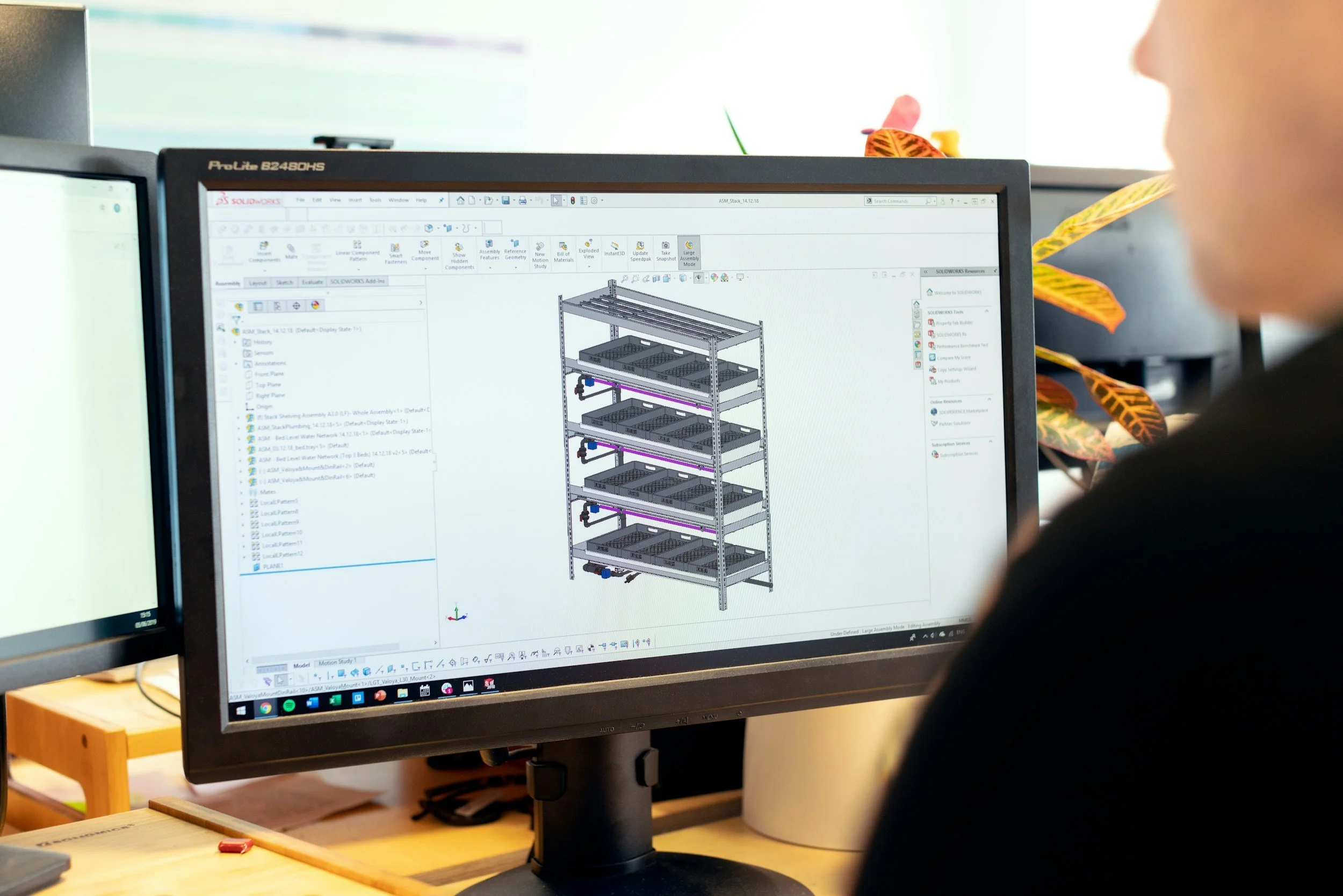
Mechanical Design & Engineering
Vitron Industries delivers end-to-end mechanical engineering solutions, from concept development through production-ready systems. Our work spans precision components to complex electromechanical assemblies, with a focus on performance, manufacturability, and scalability.
Capabilities include:
Precision Component Design – Tight-tolerance machined parts, GD&T-driven drawings, and material selection optimized for performance and cost
Assembly & System Design – Complex mechanical and mechatronic systems, including robotics, tooling, and automated equipment
Rapid Prototyping – Fast iteration using FDM 3D printing and in-house prototyping methods to validate form, fit, and function
Sheet Metal & Weldments – Production-ready designs with full consideration for fabrication processes, distortion, and assembly efficiency
Design for Manufacturing (DFM/DFA) – Optimization for CNC machining, casting, forming, and high-volume production
Optomechanical Integration – Experience integrating sensors, cameras, and laser systems into robust mechanical platforms
Laser Etching & Engraving – CO₂ laser processing for polymers, coated metals, wood, and composites (ideal for labeling, branding, and light production marking; not suitable for direct bare metal etching)
Production Transition (NPI) – Taking designs from prototype to contract manufacturing, including supplier engagement and cost-down strategies
We bring a practical, build-focused mindset shaped by real-world experience delivering robotic systems and aerospace hardware—ensuring designs don’t just look good in CAD, but perform reliably in the field.
-
Vitron Industries delivers custom software under defined requirements—scoped for traceability, documented for maintainability, and handed off so your team can own releases without ambiguity. We align deliverables to acceptance criteria and keep interfaces explicit where systems touch hardware, test, or operations.
Typical engagements cover:
Requirements & architecture – Functional and non-functional requirements captured early; decomposition into milestones, interfaces, and testable outcomes.
Implementation & quality – Application and embedded-software development with disciplined change control, code review practices suited to your program, and regression awareness as scope evolves.
Verification support – Test planning alignment, automated checks where appropriate, and evidence-oriented handoff packages that support audits and field confidence.
Documentation & transition – Build instructions, release notes, configuration baselines, and knowledge transfer so operations and sustaining engineering can support what we deliver.
We bring a contracting mindset: clear boundaries, predictable artifacts, and delivery you can integrate into your program plan—not open-ended development without an exit.
-
Vitron Industries delivers embedded contracting work across Windows and Linux targets—from bus-level bring-up through production-grade software stacks. Our focus is reproducible baselines: drivers and board support where the hardware is new or evolving, Yocto-based images when you need a maintainable Linux factory, and automation so every build is repeatable.
Engineering work spans:
Windows & Linux embedded foundations – Platform bring-up, driver and BSP support, and integration paths appropriate to your product lifecycle.
I2C, SPI & UART – Peripheral bring-up, driver bring-up, and debug support for common serial and synchronous interfaces on custom hardware.
Other common protocols – Bring-up and integration support for additional standard buses and peripherals your program calls for (e.g. CAN, USB, Ethernet, LIN)—aligned to your hardware definition, milestones, and verification plan.
Yocto / OpenEmbedded – Custom images, layers, and recipes aligned to your hardware and update strategy.
Automated builds & release hygiene – Full automated build pipelines so releases stay reproducible from integration through deployment, with artifacts suitable for manufacturing and field update processes.
We emphasize integration-ready deliverables and build systems your team can run without heroics—so embedded software stays an engineering discipline.
-
Vitron Industries brings hardware, software, and interfaces together with a verification bias—so issues surface on the bench and in structured test, not as surprises in late program phases. We work to explicit pass/fail criteria where your program demands them, and we document what was exercised and what remains as risk.
Integration support includes:
Integration planning – Sequencing hardware-in-the-loop steps, interface ownership, and entry/exit criteria between subsystem and system-level milestones.
Bench & system bring-up – Methodical build-up from power and communications through application behavior, with traceable observations and defect capture.
Interface validation – Cross-checking electrical, protocol, and software assumptions across mechanical, electrical, and software boundaries.
Issue triage support – Structured isolation support to separate hardware defects from software defects from environmental factors—reducing churn for your core team.
We bring a field-realistic mindset: integration is where programs win or lose schedule, and discipline here protects your launch.
-
Vitron Industries coordinates movement of goods with disciplined documentation, routing alignment, and operational follow-through against your timelines. We treat logistics as a program task—clear handoffs, status visibility, and attention to documentation and packaging requirements so stakeholders know what to expect and when.
Shipment execution emphasizes:
Shipment planning & routing alignment – Coordination with carriers and schedules aligned to manufacturing milestones and customer delivery windows.
Documentation packages – Commercial documentation appropriate to the shipment and commodity (e.g., invoices, packing lists, classifications as applicable)—prepared for consistency and review.
Operational follow-through – Tracking milestones, exception handling communication, and escalation paths when timelines are at risk.
Compliance-aware execution – Alignment to your requirements and applicable rules for the movement; coordination with your specialists where legal, regulatory, or carrier-specific expertise is required.
We bring operational discipline shaped by real movement constraints—so logistics stays a managed workstream, not a last-minute scramble.
-
At Vitron Industries, many projects start with a napkin sketch, a phone photo of a markup, or a dimensioned doodle. Bring that as-is—we translate the design intent into a clean solid model and deliver print-oriented STL files built to slice and print without surprises. See an example project
You get: solid geometry suitable for typical additive workflows, STL export with clear units/orientation, and assumptions called out when details aren’t fully specified.
How it works: submit a request via form with sketch photos and any dimensions or constraints. We reply with a quote and scope. The proposal states how many iteration rounds are included; additional rounds or scope growth are quoted in advance before more work proceeds.
Send: 1–5 sketch photos (flat + angled), must-have dimensions/interfaces, and print context if known (printer, build volume, material).
Print-ready here means geometry aimed at real printing—watertight solids, sensible thickness/detail, and clean export. Submission form is here
How We Work
Define Scope & Interfaces
Requirements, deliverables, and handoff expectations
Execute & Verify
Design/build/integration or logistics coordination with regular checkpoints
Deliver
Documentation, transfer, and support boundaries made explicit
Support
Ongoing needs can be covered through support agreements—including line support and renewal terms.